What if AI agents pick our travel destinations?
Bubbly AI is an AI concept design project, focusing on quick design iterations on swift UI, creating a fun and delightful engagement with AI agent based decision making.
2025 PRODUCT DESIGN
AI concept
UI design
ios
Overview
CLIENT
Self
Time
2025
Team
1 Dev, 1 Designer (Me)
Role
Product Designer
Tools
Swift. Figma
My Role
It was a self-driven iOS app dev project.
As a solo design on team, I collaborated with 1 developer to create an app.
Solution
An AI that allows multi-persona decision making
Key Features
Feature 1
Create your proxy with bubbles
Make trip planning fun. Set preferences and weights through playful bubbles and build your AI trip proxy.
Feature 2
Talk to fine-tune your trip taste
Interact with AI to adjust preference weights or receive recommended tags.
Feature 3
Put your cards on the table ♣️
AI will express your preferences for you, making it easier for the group to decide together.
Feature 4
Deal maker!
No drama, no oversharing. Bubbly will curate options based on each proxy's unique preferences analyses.
Context
Everyone is talking about AI but I found it hard to dive deeper into "UI" part for AI products.
Using the latest iOS 26 glass interfaces, I explored creating delightful interactions with "bubbles".
Problem
We have AI agents. Why not make them help group decision-making?
Current AIs are built for individuals, not groups
Group decisions are messy and difficult
Competitive Analysis
I tested a scenario of group trip planning with existing apps like Airbnb Tripadvisor, and Hotels.com.
No AI feature for groups
Even when AI was used, it was 1 person recommendation system and it didn't work in group decision-making.
No dynamic, group-aware preference setting
None of the platforms allows let users collaborately set filters/ preferences. There’s no way to balance or weigh inputs across group members.
Weak decision-making support
Airbnb has up/down voting, and TripAdvisor has comments. But neither helps users toward a shared decision.
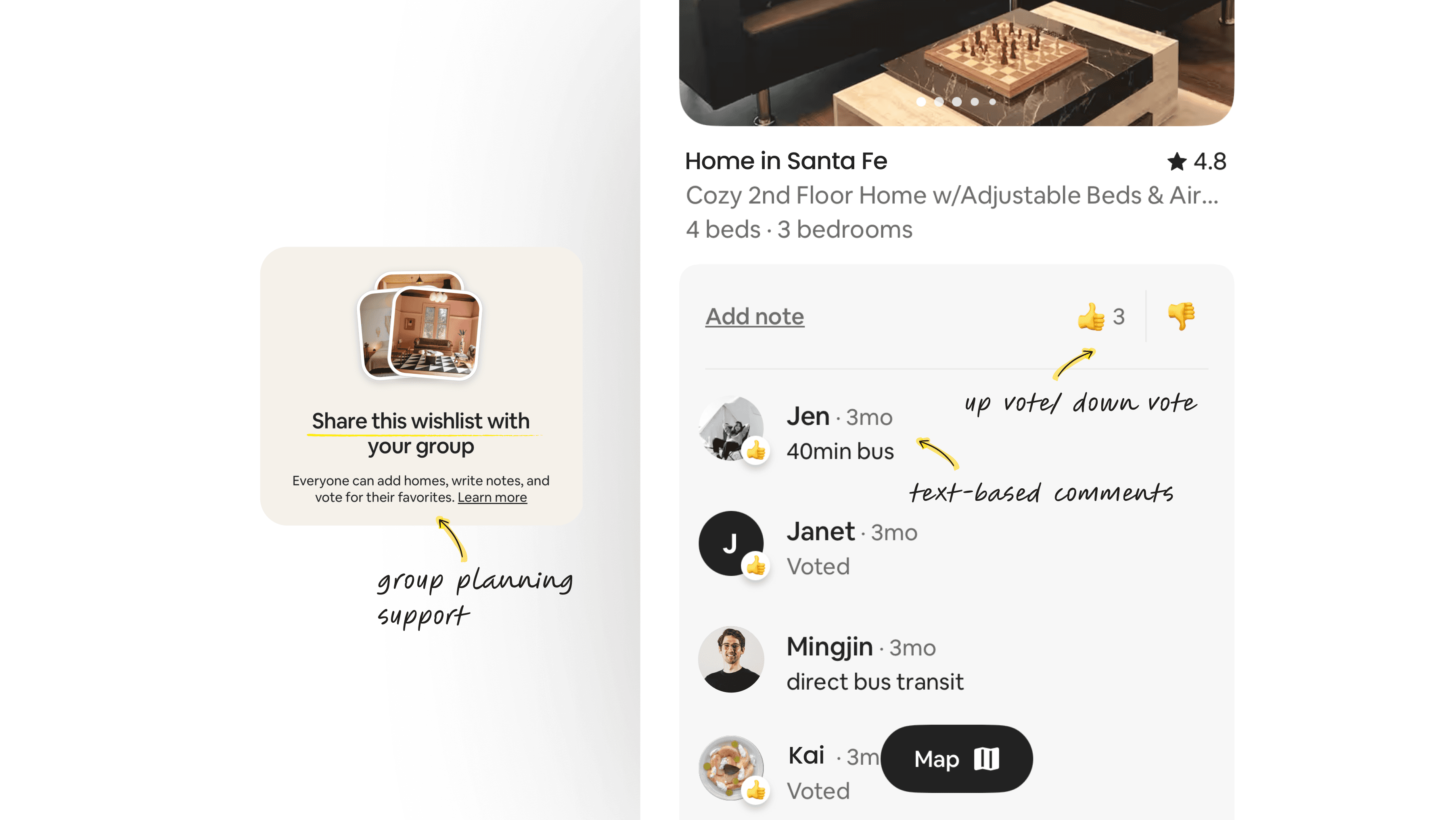
Airbnb
Airbnb had the most usable & transparent voting feature to support group decision making.

Tripadvisor
Tripadvisor also had a group wishlist, but lacked additional features to share opinions beyond text-based comments.
Initial brainstorming
What are design opportunities Through competitive analysis, I discovered design opportunities for this AI concept.
AI for a group, not just individuals
I envisioned a recommender system that can interpret and reconcile inputs from multiple users, generating suggestions that reflect the "group" perspective.
Enable dynamic preference input
The new design should allow users to set filters collaboratively, and adjust individual priorities and preferences.
Lower the inconvenience, raise the fun
By leveraging criteria-based recommender, we can ease the burden of manual compromise and negotiation, unlike the current reliance on text-based comments.
Concept
Bubble-inspired, playful trip planning!
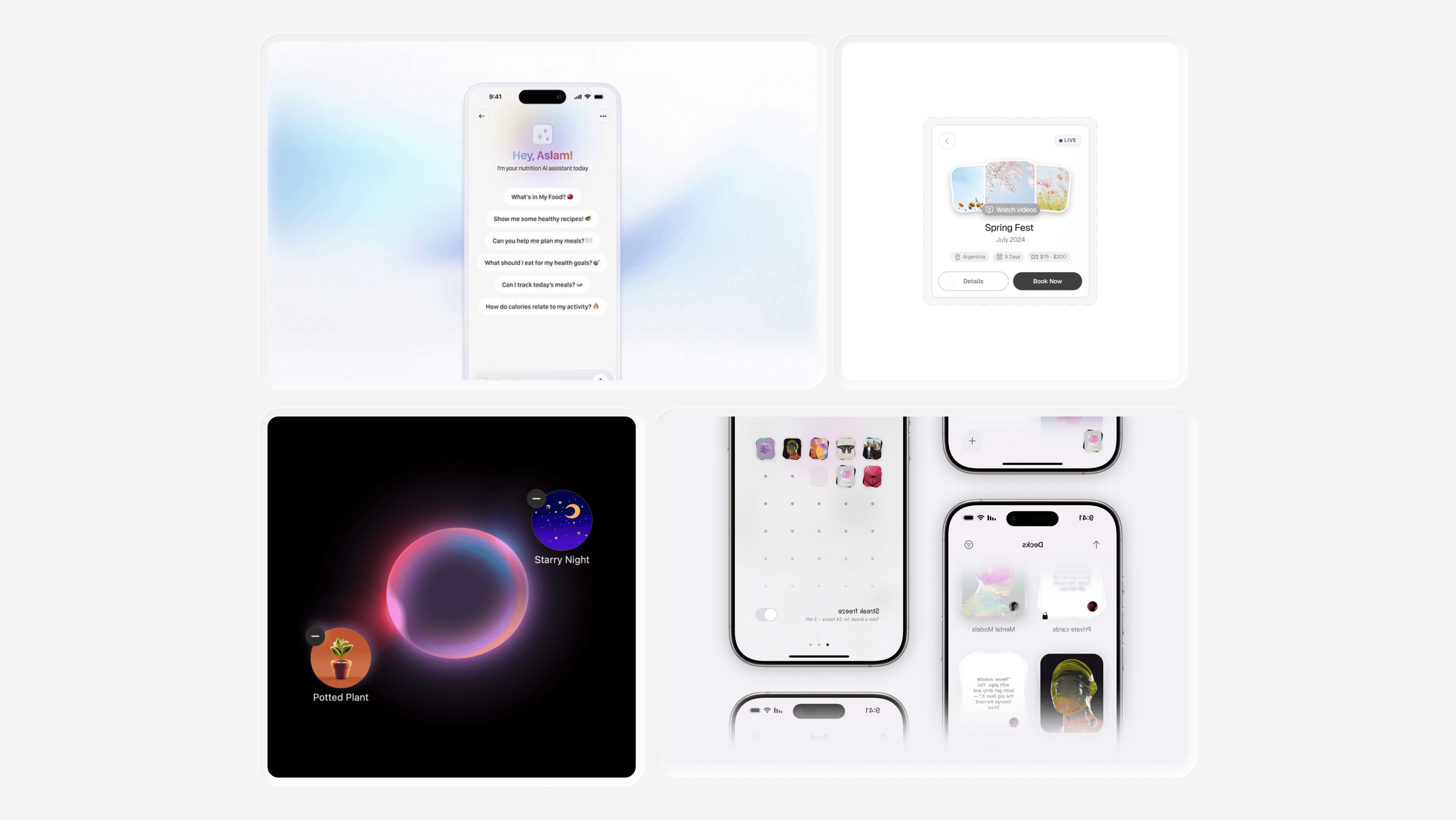
Inspired by Apple’s Image Playground, I created a moodboard for an interaction that combines a glass-like aesthetic with flexible, dynamic behavior.
Wireframes
Considering components, and the overall design system, I quickly sketched the main flows.

Flow 1
Editing preferences
Edit preference for my proxy

Flow 2
Group-AI curation
Adjust weight of each preferences
Share my proxy with friends

Flow 3
Voice and image-based AI UX
Chat with AI to adjust preference weight or receive recommended tags.
Upload images to get more personalized or related keywords (bubbles).
Design iterations
Detail 1
Aesthetic UI touch to increase the "AI" feel

1
Gradient UI
2
Liquid glass aesthetic
Detail 2
Small tweaks to increase the fun!

1
Card- placing UI
Detail 3
Novel interactions for profile editing
1
Engaging bubble interactions
Reflections
Ideas to implementation
This was my first time working on a UI-heavy project directly with a developer. I learned how to clearly translate UI and interaction needs into developer-friendly terms while iterating through constant collaboration.
Explore, learn, enjoy
At first, I felt pressured to build an AI concept by strictly following UI “must-dos.” But I soon realized it was restricting my creativity and approached it as a creative experiment. This mindset gave me the freedom to explore more.
Back to home